
"...For example, the Dogon and their ancestors were so in tune with my solar mind linked with Sirian genius that they filled the plain of Africa with a panoply of outrageous animals. Just where did you think they alle came from with all their spots, manes, horns, and tusks?" (p.208) (Channeled through Barbara Hand Clow in 'Pleiadean Agenda', 1995)
Goodday to you all!
This article tries to present to you information which I gathered from the Internet concerning the awkward knowledge of a tribe in Mali, West Africa, called the Dogon. They claim that they were given knowledge by extraterrestrials coming from Sirius C. This article does not contain channeled messages. The only channeled material I could find concerning the Dogon people stems from The Pleiadean Agenda, which I presented above. I hope you enjoy reading these pages!
Astronomy and the discoveries of various Sirius stars
Sirius (A) is known by astronomers to be the brightest star seen from planet Earth. It is part of the constellation Canis Major. It is about 8.7 light-years from Earth and is visible in the Northern hemisphere evening sky from about November through April. Sirius is over 20 times brighter than our Sun.
From 1834 to 1844 some irregularities were noticed in the movement of Sirius by F.W. Bessel. It was supposed that Sirius must be affected by a second star, and in 1862 a faint companion star was finally detected by Alvan Clark, and it was named Sirius B. It is a white dwarf that, although small and faint (about 10,000 times dimmer than Sirius A) is is extremely dense and heavy enough to exert influence on Sirius A. In 1915 the first spectrum op Sirius B was obtained by W.Adams at Mt. Wilson, which is 'all that would have been needed to classifiy it as a white dwarf (very small, yet very massive : one teaspoon of Sirius B is so dense that it weighs 5 tons! Only in 1970 the first photograph could be taken of Sirius B by Dr. Irving W. Lendenblad of the US Naval Observatory. The picture looks like this: (Sirius A in the middle and Sirius B in the lower-right corner)
In 1995 two French researchers (Daniel Benest and J.L. Duvent) published an article in Astronomy and Astrophysics with the title Is Sirius a Triple Star?. They suggest that there might be a third star, a Sirius C. Here's an abstract of the article:
Abstract (from http://cdsweb.u-strasbg.fr/): Sirius has been discovered as double more than 130 years ago. From the beginning of our century up to now, observational as well as physical and dynamical indications lead to the hypothesis of the existence of a third body in the system. In this paper, we present recent orbital analysis of the binary Sirius A-B which, helped by numerical simulation of triple systems, strengthens the idea for the triplicity of Sirius: a tiny star could revolve in about 6 years around Sirius A. Finally, we discuss the possibility of direct detection for this suspected Sirius C.
Two French anthropologists in the 1930's
Somewhere in the 1930's two French anthropologists (Marcel Griaule and Germain Dieterlen) were able to win the confidence of four Dogon priests of the Dogon people who live in the Homburi mountains near Timbuktu in Mali, West-Africa. The things they told these researchers are quite out of the ordinary. That is, at the center of their religious teachings is knowledge about a star that is invisible to the eye, which they call Po Tolo (Po=smallest seed known to the Dogon; Tolo=star). The priests said that 'Po Tolo' has an elliptical orbit around Sirius (A) and that the orbital period is 50 years (the actual figure is 50.04 +/- 0.09 years). Po Tolo was said to rotate on its own axis (it does). The Dogon also describe a third star in the Sirius system, called Emme Ya ("Sorghum Female"). On top of this knowledge their worldview was heliocentric and they knew about four moons of Jupiter and the rings of Saturn. How could they have known all this?
They claim that the knowledge was given to them by a race people from the Sirius system called the Nommos ("to make one drink") who visited Earth thousands of years ago. They are said to have come from a planet orbiting Sirius C. The Nommos were ugly, amphibious beings that resembled mermen and mermaids. These Nommos are said to also occur in Babylonian, Accadian, and Sumerian myths (the sumerians god 'Oannes' is said to be very similar to the Dogon description of Nommos). According to the Dogon legend, the Nammos lived on a planet that orbits another star in the Sirius system. They landed on Earth in an 'ark' that made a spinning descend to the ground with great noise and wind.
The Dogons have celebrated their customs for hundreds and hundreds of years which can be determined by numbering the ornate customs and relics that their leaders prepared for their great festival held once every 60 years. With several extant masks in various stages of decay, researchers have determined Dogon traditions to be well over a thousand years old.
Criticism
Although the Dogon-story is mind-boggling when it is true. Some critics strongly doubt the validity of it all. In response to a book ('The Sirius Mystery') written by Robert K.G. Temple in 1977 (with a more recent version, responding to the possible trinary nature of Sirius) astronomer Carl Sagan said that modern knowledge of Sirius must have come from westerners who must have talked to the Dogon priests before the anthropologists arrived. The priests probably incorporated these facts into their traditions.
In 1992 Walter van Beek, a Dutch Professor from the University of Utrecht, published an article in Current Anthropology named 'Dogon Restudied'. He studied the Dogon and could not find any evidence that they knew Sirius was a double star. Another source (Jay Ingram) says that van Beek found that the vast majority of these people knew nothing about Sirius having an invisible companion. According to Thomas Bullard, van Beek speculates that Griaule (the French anthropologist) wished to affirm the complexity of African religions and questioned his informants in such a forceful leading manner that they created new myths by confabulation.
The festivities mentioned above which take place every sixty years are not in compliance with the 50 years periode of Sirius B around Sirius A.
Playfair & Hill
In 'The Cycles of Heaven' by Guy Playfair and Scott Hill (1978) we can read about the Dogon as well. In addition to the information already presented above they say that the Dogon have long known about the circulation of the blood: they have known that there is 'red and white blood'. They have compared the bloodstream with the Milky Way. The Dogon claim that life on Earth descends from amphibious creatures from the Sirius system who came here in spacecraft. These include descriptions of a third star in the Sirius system, larger than Sirius B, with an orbital period of 32 years, and also a planet. (p.247)
I want to thank a Turkish reader who informed me about a verse in the Quran which speaks of the 'Lord of Sirius' (Sura 53, verse 49) which I found rather surprising. I have taken an excerpt from the Quran. Click here to read more about the context from which this verse is taken: http://cwis.usc.edu/dept/MSA/quran/053.qmt.html
While reading the 'Pleiadean Agenda', from which I took the quote on top of the page, I first encountered the Dogon tribe. Curious to see what is known about the possible links between these African people and Sirius I started to look on the internet and I collected information from various sources. I intend to photocopy the two scientific articles mentioned in the articles-section, so I can have a first-hand look at these sources.
I tend to think that the Dogon-people (at least in the 1930's) knew about Sirius B, Sirius C, four moons of Jupiter and the rings of Saturn, not from Western scientists, but from another source. It is rather strange to think of beings from a Sirian C planet to have come to Earth to instruct both the Dogon and the Egyptians, probably somewhere around 3600 B.C., in pre-dynastic Egypt (in an article by Jasmine Courneya I read that the Sirius information was possessed by the Egyptians in pre-dynastic times before 3200 B.C.). This periode strongly reminds me of something I came across in this Pleiadean agenda concerning the Nibiru-planet. For those who are interested in the possibility that the Nommos are actualy beings from Nibiru, try to delve into Nibiruan texts and the interesting Sumerian stories on Enki and Enlil. The work of the scholar Sir Laurence Gardner on the Sumerian texts and the Bible has some ground in common with this possible link with the Nibiruan Annunaki who are supposed to have come from Sirius as well. In order to clarify the links between Earth, Nibiru and the Siriusstars I have provided the interested reader with a Digitaria page. I still don't know what to think really.
If you have interesting information to share on this topic please mail me!
* Sirius and Channeled information on Sirius *
The mysteries of Sirius
The Dogon, the Nommos and Sirius B: (the unnatural museum) *
The Dogon tribe (Sphinx group)
* The Dogons of Mali, West Africa * Can Tales of Sirius be Seriously? by Jay Ingram * The Dogon and Sirius (Skeptic's dictionary) * The Dogon Tribe & the Dog Star Sirius * The mysteries of Sirius * Karl Heinz & Uwe Homann's scientific approach to the Sirius mystery
This, however, does not explain a 400-year old Dogon artifact that apparently depicts the Sirius configuration nor the ceremonies held by the Dogon since the 13th century to celebrate the cycle of Sirius A en B. It also doesn't explain how the Dogons knew about the super-density of Sirius B, a fact only discovered a few years before the anthropologists recorded the Dogon stories.
053.049
YUSUFALI: That He is the Lord of Sirius (the Mighty Star);
PICKTHAL: And that He it is Who is the Lord of Sirius;
SHAKIR: And that He is the Lord of the Sirius;
Personal Comment
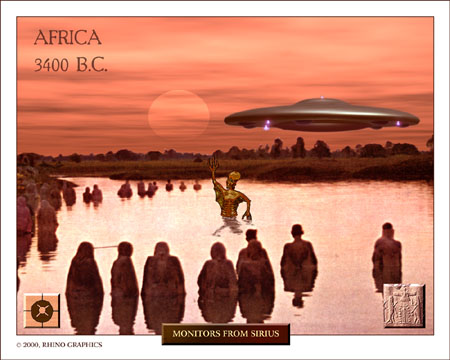 Monitors from Sirius

 Back to gibbon's main page