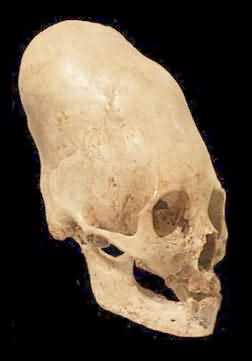
In November 2007 I received an email from someone who directed me to a site that dealt with 'strange' skulls that were found in Peru. On the site (Deformed Ancient Skulls) you can take a look at some of these skulls and read about their characteristics.
When reading through that page I found a few interesting things, relating to the size of the cranial vault. I would advice to read the original text to get a picture of the mentioned 'J' and 'M'-types. Would it be signs of the later stages of the Grand Master skulls? The excerpts below are written by Lumir G. Janku:
More significant is the enormity of the cranial vault. The estimated cranial capacity ranges between minimum of 2600 ccm to 3200 ccm. [modern human beings have a cranial capacity of about 1450 ccm, whereas the Neanderthals and Cro-Magnon humans had respectively capacities of 1600 ccm and 1750 ccm, The decrease of the cranial capacity (sudden at that -- the specimens of modern humans after about 10500 BCE have smaller craniums) is a puzzling matter, but that's another story].
Both "J" and "M" types are bordering on biological impossibility. The only explanation I can imagine for the specimens to be naturally born is if the neoteny (the ability of the species to prolong the growth period before maturing) of both groups had been expanded beyond the range for a modern type of human, for the skull to grow to such a size. That may also mean the average life span of these specimens may have been substantially longer than the average for the modern human type.
The "M" type of skull is incomplete, as the lower part of the facial area is concerned. What is apparent from the remnants of the facial portion is that the characteristics are entirely within the range of a normal human skull. The cranial vault, on the other hand, is the largest amongst the displayed specimens. Also, the two protruding "lobes" are highly anomalous. The cranial capacity can be estimated safely above 3000 ccm mark.
Any conjectures that what these specimens represent are simply deformations or pathological cases can be hardly substantiated. Anomalous types of growth or shapes appear from time to time in the modern human population, however, these occurrences are still within the range of the given species. The largest skull documented in the medical literature had the cranial capacity of 1980 ccm, however, the shape of the skull was normal. Also, it is necessary to keep in mind that any pathological growth of the cranium has dire consequences for the afflicted individual at the early stage of the development, practically without exception. Nature is very unforgiving in this respect. All the specimens presented here were mature individuals.